-
Oak Brook
📍📞 630-705-99992625 Butterfield Rd. Suite 102E
Oak Brook, IL 60523📠 Fax: 630-705-1422✉️ inquiry@vervecollege.edu 🗺️ Open in Google Maps 🍎 Open in Apple Maps🕒Office HoursMon–Fri: 9:00 AM – 6:00 PM
Sat: 10:00 AM – 4:00 PM
Sun: Closed -
Chicago
📍📞 312-920-8822216 W. Jackson Blvd. Suite 900
Chicago, IL 60606📠 Fax: 312-658-0775✉️ inquiry@vervecollege.edu 🗺️ Open in Google Maps 🍎 Open in Apple Maps🕒Office HoursMon–Fri: 9:00 AM – 6:00 PM
Sat: 10:00 AM – 4:00 PM
Sun: Closed - Email:inquiry@vervecollege.edu
- Make a Payment
 Sign up
 Login
Login
- Home
- Programs
- Admission
- Resources
- ATI Entrance Exam Resources
- New E-Digital Library
- Refer a Friend
- School Newsletter
- Events
- Employers
- Job-Network
- Alpha Beta Kappa Candidates
- Verve College Library
- Graduation and Pinning Ceremony Photo Galleries
- Textbook Information
- Career Services
- Tutoring
- School Catalog
- FAQ
- Constitution Day Program
- Alumni
- Verve College Plans
- Financial Aid
- HEERF Reporting
- Satisfactory Academic Progress
- Apply For Financial Aid
- Net Price Calculator
- Return of Title IV Funds (R2T4)
- Financial Aid Office Code of Conduct
- Contact
- FAQs
- Verification Policy
- Vaccination Policy
- Student Right-to-Know Act
- Misrepresentation
- Information Security Program
- Academic Award Year
- Availability of Employee
- Cost of Attendance
- Health & Safety Exemption Requirement
- Students Rights and Responsibilities
- Leave of Absence
- Pell Formula
- Military Students
- Grants/ Scholarship Policy
- Contact Us
- Testimonials
- Blog
Is a Nursing Career Right For You?
Take The Free Quiz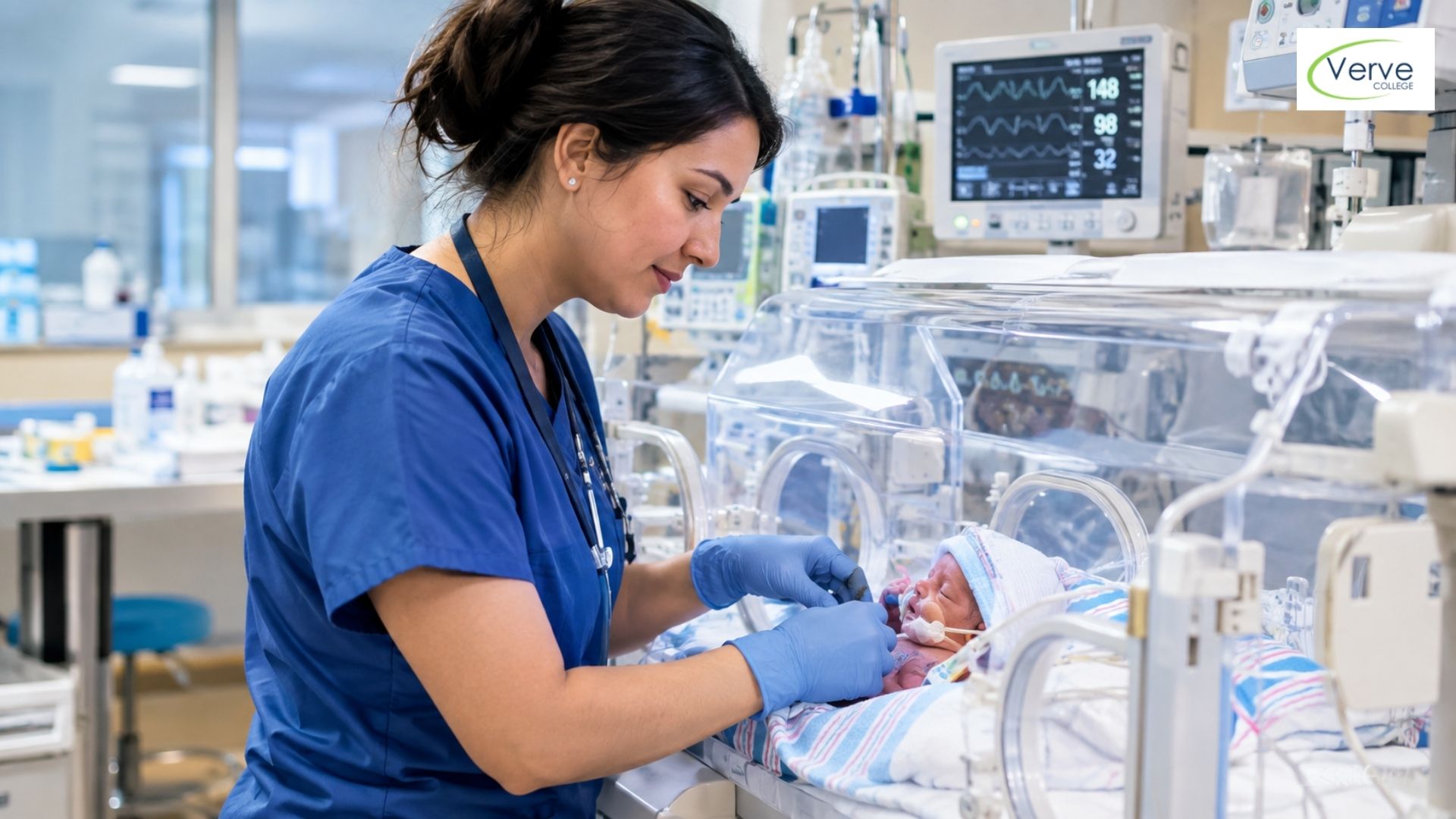
Neonatal Nursing: What Does a NICU Nurse Do?
Neonatal Nursing: What Does a NICU Nurse Do?
Newborns are among the most vulnerable patients in healthcare. When babies are born prematurely, experience complications, or face health challenges, they enter the NICU (Neonatal Intensive Care Unit), where specialized neonatal nursing provides expert care. Neonatal nursing focuses on caring for critically ill or premature newborns during some of the most important days of their lives. A NICU nurse combines high-level clinical skills with gentle care for fragile patients who cannot communicate their needs. If you’re exploring nursing specialties and wondering about careers focused on maternal and newborn health, understanding neonatal nursing reveals how nurses make critical differences during vulnerable moments in family life.
Key Takeaways
- Neonatal nursing specializes in caring for premature, ill, or at-risk newborns in intensive care settings.
- NICU nurses work with extremely fragile patients requiring constant monitoring, specialized equipment, and precise technical skills.
- Common responsibilities include vital sign monitoring, medication administration, respiratory support, feeding management, and family education.
- Neonatal nurses care for babies with conditions like prematurity, respiratory distress, infection, congenital anomalies, and cardiac complications.
- Strong attention to detail, gentle hands-on skills, emotional resilience, and family-centered communication are essential.
- A foundation in nursing programs in Illinois provides the clinical preparation to eventually specialize in neonatal care.
- Career growth in neonatal nursing offers opportunities for specialization, education, and leadership in maternal-child health.
What Is Neonatal Nursing?
Neonatal nursing is a specialized field focused on caring for newborns during their most vulnerable days. NICU nurses provide intensive care for premature infants, full-term babies with complications, and newborns with serious health conditions requiring constant monitoring and intervention.
Unlike most nursing specialties where patients can communicate their symptoms, newborns cannot tell nurses what’s wrong. Neonatal nurses must recognize subtle signs of distress, interpret monitor data, and respond quickly to changes. This requires specialized knowledge about newborn physiology, development, and common conditions.
Neonatal nursing extends beyond medical care to family support. Parents of NICU babies experience fear, grief, and stress. Neonatal nurses provide emotional support, explain complex medical situations, teach parents how to care for their babies, and help families adjust to the NICU experience.
The NICU Environment
The NICU is unlike other hospital units. Alarms sound constantly as monitors track vital signs. Babies connected to ventilators, IV lines, and monitoring equipment appear extremely fragile. Specialized equipment surrounds each bed. The environment is simultaneously high-tech and deeply human.
NICUs typically have different levels corresponding to the acuity of care provided. Level I units provide basic care for healthy newborns needing observation. Level II units care for moderately ill or premature babies. Level III units provide intensive care for critically ill newborns. Level IV units offer the highest level of care, including extracorporeal membrane oxygenation (ECMO) and other advanced interventions.
Despite the technology and intensity, quality NICUs emphasize family-centered care. Parents are encouraged to be present, participate in care, and bond with their babies even while they’re critically ill.
Common Conditions in Neonatal Nursing
NICU nurses care for babies with various conditions.
Premature infants represent a large portion of NICU patients. Prematurity causes immaturity across all body systems. Premature babies struggle with breathing, feeding, temperature regulation, and infection risk. Neonatal nurses support them through these challenges as they mature.
Respiratory distress syndrome affects babies whose lungs haven’t fully developed. These babies require oxygen support, sometimes mechanical ventilation. Careful respiratory management is essential.
Infection in newborns becomes serious quickly. Neonatal nurses recognize signs of infection, administer antibiotics, implement infection control measures, and provide supportive care while the baby’s immune system fights infection.
Congenital anomalies (birth defects) require specialized care. Some babies need surgery shortly after birth. Others need medical management of complex conditions. Neonatal nurses care for these babies through diagnosis, treatment, and adjustment.
Cardiac conditions in newborns range from minor to life-threatening. Some require medication or surgical intervention. Neonatal nurses monitor cardiac status closely and recognize complications.
Key Responsibilities of a NICU Nurse
Patient Assessment and Monitoring
NICU nurses continuously monitor babies’ condition. Vital signs, oxygen levels, heart rate, and temperature require constant attention. Nurses recognize subtle changes suggesting problems before they become emergencies.
Physical assessments are detailed and frequent. Nurses examine babies for jaundice, skin integrity, hydration status, and signs of infection. They monitor intake and output meticulously.
Medication Administration
Premature and ill newborns require various medications. NICU nurses administer medications through different routes (IV, oral, injected) with precision. Medication dosages for tiny babies require extreme accuracy.
Respiratory Support Management
Some babies breathe independently. Others need oxygen support. Some require mechanical ventilation. NICU nurses manage these systems, assess respiratory status, and recognize when changes are needed.
Feeding Support
Feeding challenges are common in NICU babies. Some babies are too immature to suck and swallow. NICU nurses provide nutrition through gavage feeding (tube feeding) initially, gradually transitioning to bottle or breast feeding as babies mature.
Family Support and Communication
Parents need to understand their baby’s condition, treatment plan, and what to expect. NICU nurses explain complex medical information in understandable language. They answer questions repeatedly without frustration.
Mothers pumping breast milk need support and encouragement. Parents learning to diaper, bathe, or comfort their baby need patient teaching. Families experiencing fear and uncertainty need emotional support.
Equipment and Technology
NICU environments contain sophisticated equipment. Ventilators support breathing. Monitors track vital signs continuously. IV pumps deliver medications and nutrition precisely. Phototherapy lights treat jaundice. Incubators maintain temperature and humidity.
Neonatal nurses master these technologies, troubleshoot problems, and interpret the data they provide. When alarms sound, nurses respond quickly and appropriately.
Skills Required for Neonatal Nursing
Successful NICU nurses develop specific competencies.
Attention to detail is critical. Tiny babies have little margin for error. Medications accurate to decimal points, feeding amounts precise to milliliters, and vital sign changes that seem minor can have major implications.
Gentle hands-on skills are essential. These tiny babies are fragile. Nurses learn techniques causing minimal distress while accomplishing necessary care.
Technical competency with specialized equipment is required. Neonatal nurses understand complex systems and troubleshoot problems quickly.
Communication skills matter enormously. Explaining frightening situations to frightened parents requires clarity, compassion, and honesty.
Emotional resilience is necessary. Not all babies survive. Nurses caring for dying babies while supporting grieving families need strong emotional coping.
Problem-solving skills help nurses adapt to each baby’s individual needs and challenges.
Education and Career Pathway
Becoming a NICU nurse requires foundational nursing education and licensure. Most neonatal nurses start with LPN or RN credentials. Quality practical nursing education in Illinois provides strong clinical preparation supporting eventual specialization.
After licensure and gaining experience in various settings, nurses transition to NEONATAL nursing. Many develop NICU expertise through clinical experience and education. Others seek neonatal nursing early in their careers.
Certification is available through organizations like the National Certification Corporation (NCC). The Certified Neonatal Nurse (CNN) credential demonstrates specialized expertise.
Is Neonatal Nursing Right for You?
Neonatal nursing appeals to nurses motivated by caring for the most vulnerable patients, communicating with frightened families, and making a difference during critical moments.
It’s less suitable for nurses who struggle with high-acuity care, become overwhelmed when babies don’t survive, or prefer minimal family involvement in patient care.
Exploring neonatal experiences during nursing education helps determine fit. Some hybrid practical nursing education programs include maternal-child health content. Learning about neonatal care and understanding how it connects to antepartum care provides context for women’s health specialization.
Conclusion
Neonatal nursing focuses on caring for critically ill or premature newborns during their most vulnerable days. NICU nurses combine advanced technical skills with genuine compassion for fragile patients and frightened families. This specialty offers the unique satisfaction of making profound differences during critical moments in family life and celebrating babies’ progress from NICU to home.
If you find meaning in supporting the most vulnerable patients, communicating clearly with frightened families, and taking satisfaction in tiny progress steps, neonatal nursing might be your calling. The field offers opportunities to make meaningful differences in newborn outcomes and family experiences.
Get Your Nursing Career Training Readiness Score Now!
Frequently Asked Questions (FAQs)
What is the difference between a NICU nurse and a regular nurse?
A NICU nurse specializes in caring for critically ill or premature newborns requiring intensive monitoring and specialized care. Regular nurses work in various settings caring for different patient populations. NICU nurses have specialized knowledge about newborn physiology, neonatal conditions, and critical care interventions specific to babies.
Do all NICU nurses give care to babies born with genetic conditions?
NICU nurses care for babies with various conditions, including genetic and congenital conditions, but genetic conditions are just one category of patients. Many NICU patients are premature babies without genetic conditions. NICU nurses care for any critically ill or at-risk newborn requiring intensive care.
What education do I need to become a NICU nurse?
You need nursing licensure first, either as an LPN or RN. After licensure and gaining clinical experience, you can transition to neonatal nursing. While not required, certification through the National Certification Corporation demonstrates specialized expertise. Many nurses develop NICU expertise through clinical experience and education after initial licensure.
Most Popular Blogs Posts

What Is Cardiac Output? A Simple…
October 6, 2026 Read More
What Should You Look for in…
October 6, 2026 Read More
How LPN Training Prepares Students for…
October 5, 2026 Read More
What Is Inflammation? A Simple Guide…
October 1, 2026 Read More